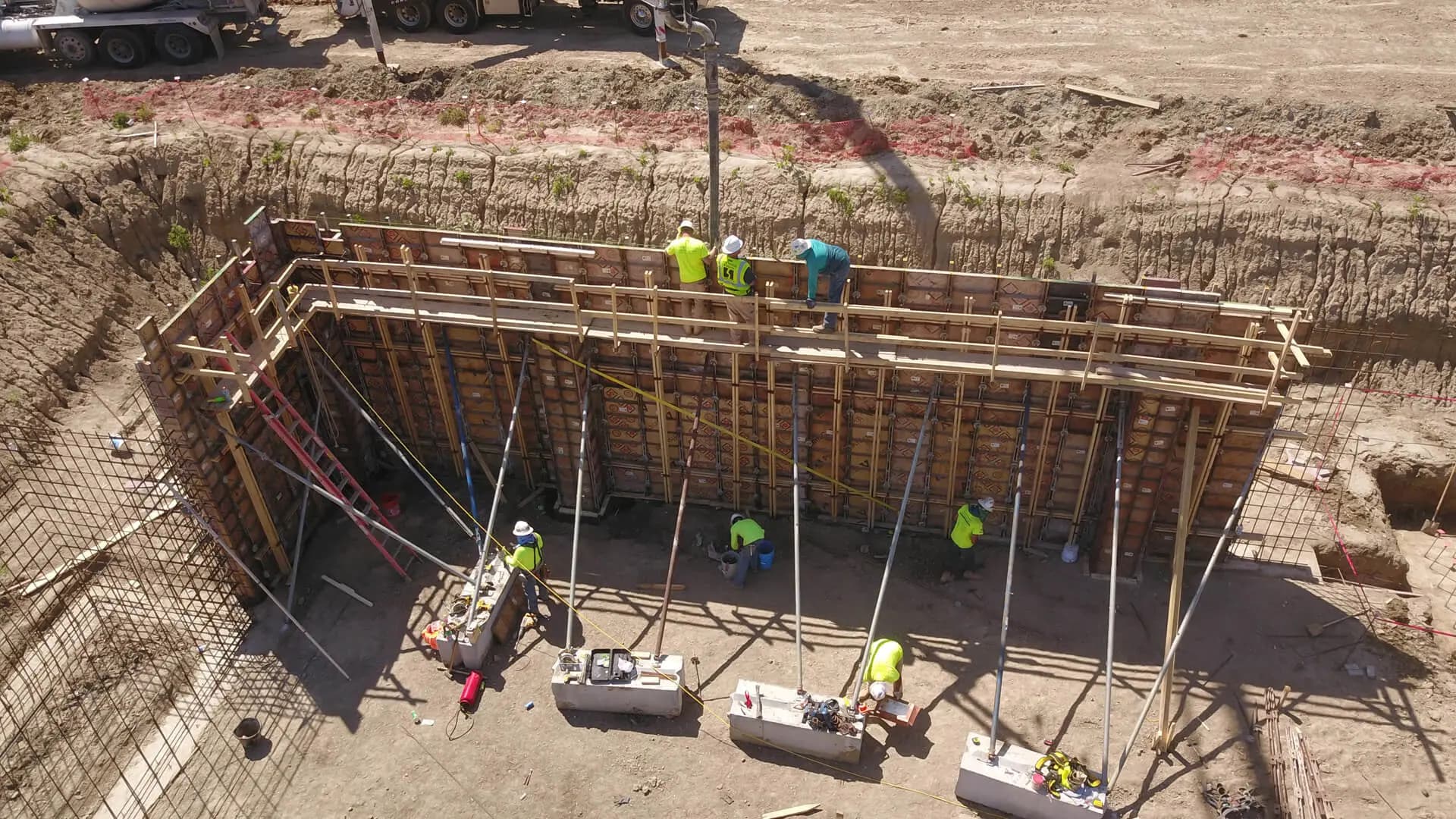
Overview
General Contractors of Bryan manages concrete foundations and slab-on-grade construction for commercial and industrial projects where foundation performance determines the long-term durability of everything built above it. In Bryan and throughout Brazos County, that means working with Houston Black expansive clay — one of the most challenging and most common subgrade conditions in Texas. The clay moves with moisture changes, shrinking during the hot, dry Bryan summer and swelling after Gulf-track rainfall events. Foundations and slabs that are not designed and built to account for that movement will crack, settle, and fail within the first few years of service.
The solution is not complicated, but it requires front-end discipline that many projects skip: proper geotechnical investigation, engineered slab and foundation design based on actual soil conditions, moisture-conditioning of subbase soils before concrete placement, and pour-day protocols that account for evaporation rates in central Texas summer heat. We require all of those elements on every foundation and slab project we manage in the Bryan area.
Foundation and slab work is also a critical-path handoff point. The structural frame, tilt-wall panels, PEMB erection, and every interior trade depends on a foundation system that is completed, cured, and verified before the next phase begins. Managing that handoff carefully — not rushing concrete placement and curing under schedule pressure — is one of the highest-value things a general contractor can do on a Bryan commercial or industrial project.
What Concrete Foundations and Slab-on-Grade Includes
Foundation and slab-on-grade construction is managed as a quality-controlled scope from subgrade verification through structural release. Each phase has hold points that protect the work above it.
- Subgrade readiness verification with geotechnical testing on Brazos County clay soils
- Moisture-conditioning and structural fill placement where expansive clay requires treatment
- Reinforcement and embedded-item coordination reviewed against structural drawings before placement
- Pour-day logistics including weather monitoring, evaporation retarder application, and crew readiness
- Curing and protection management through the minimum cure period
- Slab-joint layout and sawcut scheduling to control cracking
Our Concrete Foundations and Slab-on-Grade Process
Foundation and slab delivery follows a disciplined sequence from site preparation through structural release. Quality hold points at subgrade, reinforcement, and curing phases protect the long-term performance of the concrete system.
01Subgrade and survey confirmation
Before any concrete work begins, we verify subgrade conditions through geotechnical testing and compare them against the structural engineer's design assumptions. For Bryan projects, this means confirming that expansive clay conditions at depth match what the foundation designer used for soil swell and consolidation parameters. Discrepancies are resolved with the structural engineer before any forming begins.
Rebar and embed review
Reinforcement placement and embedded items — anchor bolts, conduit sleeves, drain frames, slab edge forms — are verified against structural drawings before concrete is ordered. Rebar grade, spacing, and cover are checked by our field superintendent. Embeds are located, leveled, and supported against the structural layout drawings. This is a no-pour-order hold point.
Placement sequencing
Pour-day sequencing is planned against the weather forecast, concrete truck delivery schedule, finishing crew size, and curing material availability. In Bryan's summer heat, we require concrete placement to begin before 7 AM on days when afternoon temperatures are forecast above 90 degrees. Evaporation retarder is applied continuously during finishing on hot, dry, or windy days to prevent plastic shrinkage cracking.
Cure and tolerance checks
Curing compound or wet cure is applied immediately after finishing and maintained for the minimum period specified by the structural engineer. Floor flatness readings are taken on slabs with defined tolerance requirements — superflat, F-number, or defined-movement specifications. Tolerance failures are reported to the structural engineer and owner before any vertical construction begins on the affected area.
Release to structure
Foundation and slab release to structural trades includes a written verification that concrete has achieved the specified compressive strength, anchor bolt positions have been surveyed and documented, curing is complete, and all post-installed embeds have been set. We do not release the structure verbally — the release documentation protects the owner and ensures the next trade inherits a confirmed, defect-free substrate.
Where Foundation and Slab Construction Creates the Most Value in Bryan
Foundations and slabs are the starting point for every above-grade structure. These applications represent where proper concrete management has the greatest long-term impact in the Bryan market.
Warehouse and Industrial Slabs
Industrial floor slabs in the Bryan market carry forklift loads, pallet racking, and heavy vehicle traffic that accelerate deterioration if the slab was not designed and built to the right tolerance and reinforcement specification. We coordinate warehouse slab design with the owner's racking and materials handling vendor to ensure the floor performs for the operation it is meant to support.
PEMB and Tilt-Wall Foundations
Pre-engineered metal buildings and tilt-wall structures both depend on precise anchor bolt placement and foundation construction. We manage those systems with manufacturer-specific tolerances, geotechnical verification, and pour-day quality protocols that protect the structure above.
Commercial Building Foundations on Bryan Clay
Retail, office, and medical office buildings on Brazos County clay require either a deep foundation system or an engineered slab-on-grade with moisture-conditioning and under-slab barrier systems that control soil moisture variation. We work with the structural engineer to select the appropriate system for the site conditions and building program.
Multi-Building Site Packages
Campus-scale projects in Bryan benefit from a general contractor who manages the foundation and slab package across multiple structures with consistent quality standards, coordinated pour scheduling to avoid subcontractor conflicts, and a single documentation system that covers all structures in the package.
Weather, Soil Conditions, and Bryan Concrete Management
Bryan's summer climate is the primary concrete placement challenge in this market. June through September brings high temperatures, variable humidity, and wind conditions that accelerate evaporation from fresh concrete surfaces. We schedule large pours for early morning start times, maintain evaporation retarder on the truck, and have curing materials ready at the pour site before concrete trucks arrive.
Brazos County Houston Black clay is a high-plasticity, expansive soil that creates slab and foundation movement if subbase preparation is skipped or undersized. We require geotechnical reports for every new foundation project in Bryan and coordinate the structural design with the report findings before forming begins.
Related Markets
This service is available across Bryan and nearby regional markets where commercial and industrial owners need one accountable project lead from planning through closeout.
Bryan, TX
Bryan is the industrial and heritage anchor of the Brazos Valley — a working city with manufacturing roots, a historic downtown Texas Avenue corridor, Blinn College, the Texas A&M Health Science Center, and active commercial growth along Highway 6 and the RELLIS Campus corridor.
View location page
College Station, TX
College Station adds university-adjacent commercial demand, medical growth, and mixed owner-user projects to the broader Bryan market, with active corridors and user-facing finish requirements driven by the TAMU community.
View location page
Wixon Valley, TX
Wixon Valley is a small unincorporated community within Bryan's service radius where owner-user commercial buildings, support industrial, and agricultural-adjacent facilities benefit from general contracting with local Brazos Valley knowledge.
View location page
Hearne, TX
Hearne is a Robertson County logistics and industrial support market north of Bryan along the Highway 6 and US 79 corridor where warehouse delivery, fleet terminals, and service-commercial buildings need practical general contracting.
View location page
Caldwell, TX
Caldwell is the Burleson County seat on the Highway 21 corridor connecting Bryan to the Austin market, with owner-user commercial and industrial construction driven by agricultural services, local business growth, and the county's working agricultural economy.
View location page
Franklin, TX
Franklin is the Robertson County seat north of Bryan on the Highway 6 corridor with civic, commercial, and industrial-support construction demand for county government, local businesses, and the agricultural economy.
View location page
Frequently Asked Questions
How does Houston Black clay in Bryan affect foundation design choices?
Houston Black clay is highly expansive, meaning it swells significantly with moisture gain and shrinks during dry periods. Building foundations and slabs in Bryan must either be designed to tolerate that movement through post-tensioned slab systems, or the soil must be moisture-conditioned and protected with under-slab barriers to limit seasonal moisture variation. The structural engineer determines the appropriate approach based on geotechnical data.
What time of year is best for concrete foundation work in Bryan?
October through April offers the most favorable concrete placement conditions in Bryan — lower temperatures, lower evaporation rates, and more predictable moisture conditions. Summer work is manageable with early-morning start times and evaporation retarder, but it requires more active quality management than cool-weather placement.
Can General Contractors of Bryan manage post-tensioned slab construction?
Yes. Post-tensioned slabs are commonly specified for commercial and industrial buildings on Bryan's expansive clay soils because the active prestress limits the slab's response to soil movement. We coordinate the PT subcontractor's strand layout, chair placement, and stressing sequence with the structural engineer's requirements.